
Loading





Pristine Montessori primary classrooms are guided by Montessori-certified lead guides. Each Primary Guide is assisted by dedicated Assistant teachers. Our classrooms are designed with carefully chosen Montessori materials that are tactile and designed to teach specific concepts. These materials often involve hands-on learning and are intended to be self-correcting. Everything in the classroom is organized and accessible, enabling children to learn how to handle and care for materials responsibly.
One of the cornerstones of the Montessori approach is the “prepared environment.” Our classroom is carefully organized, aesthetically pleasing, and filled with purposeful materials made from natural elements like wood, metal, and fabric. Everything in the classroom is child-sized and accessible, encouraging freedom of movement and choice. Children are free to choose their work and engage with materials at their own pace, developing intrinsic motivation and a sense of responsibility for their learning.
Montessori classrooms typically include a three-year age span—usually ages 3 to 6—which creates a family-like community. Younger children learn by observing older peers, while older children solidify their knowledge and develop leadership skills by guiding younger ones. This structure supports social-emotional growth and allows children to develop at their own pace, without the pressure of competition.
The classroom is divided into distinct learning areas: Practical Life, Sensorial, Language, Mathematics, and Cultural Studies. Each area offers materials that are thoughtfully sequenced and designed to meet the developmental needs of children in this age range.
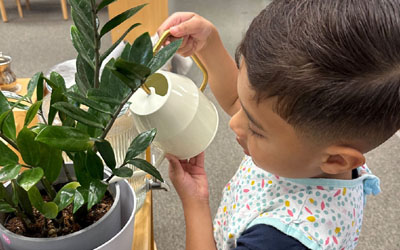
Practical Life activities are foundational in the Montessori environment. These include everyday tasks such as pouring, spooning, buttoning, sweeping, and food preparation. Through these activities, children develop fine motor skills, coordination, concentration, and a sense of independence. These exercises also help children build the confidence to care for themselves and their environment.
Sensorial materials help children refine their senses and understand abstract concepts through concrete experiences. Materials like color tablets, sound cylinders, and geometric solids are designed to isolate specific qualities—such as color, texture, weight, and size—and support the development of observation, comparison, and categorization skills. This area lays the groundwork for future learning in math, language, and science.
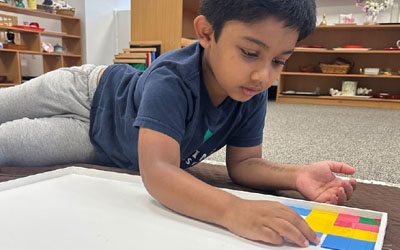
Language development in the Montessori classroom is rich and integrated into all aspects of the environment. Children are introduced to vocabulary through conversation, storytelling, songs, and classified cards. They begin pre-writing exercises through materials that strengthen hand muscles and develop control. The Montessori approach introduces phonetic awareness using sandpaper letters, moveable alphabets, and other tactile materials. Children gradually progress from writing to reading at their own pace, often surprising parents with their early literacy skills.
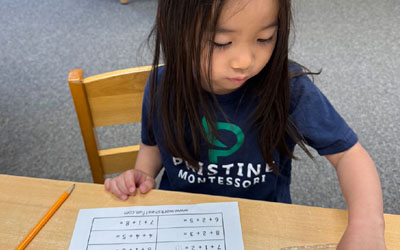
Mathematical concepts are introduced through hands-on materials that make abstract ideas concrete. Children begin with number rods, sandpaper numerals, and spindle boxes, gradually progressing to more complex concepts like the decimal system, addition, subtraction, multiplication, and division. Through manipulation of these materials, children gain a deep understanding of number relationships and mathematical operations.
Montessori cultural studies introduce children to geography, science, art, music, and world cultures. Using puzzles, globes, and hands-on materials, children explore continents, landforms, and the natural world. Science experiments encourage inquiry and curiosity, while stories and artifacts introduce children to traditions and celebrations from around the globe. This area of learning helps children develop respect and appreciation for diversity and the interconnectedness of all people.
Montessori education is centered on the belief that children are naturally driven to learn. Given the right environment, they will choose activities that support their development. Teachers observe rather than dictate, stepping in when guidance is needed but allowing children to make decisions and problem-solve independently. This nurtures self-confidence and builds a sense of agency that supports lifelong learning. Children are taught how to care for their materials, put their work away, and respect the space and work of others. These expectations foster responsibility, self-regulation, and a sense of community.
While Montessori education is well-known for fostering strong academic skills, its benefits extend far beyond the classroom. Children develop independence, adaptability, empathy, and critical thinking—qualities essential for success in school and life. Our parents often remark on their child’s confidence, self-motivation, and love of learning, all of which are fostered in a Montessori setting.